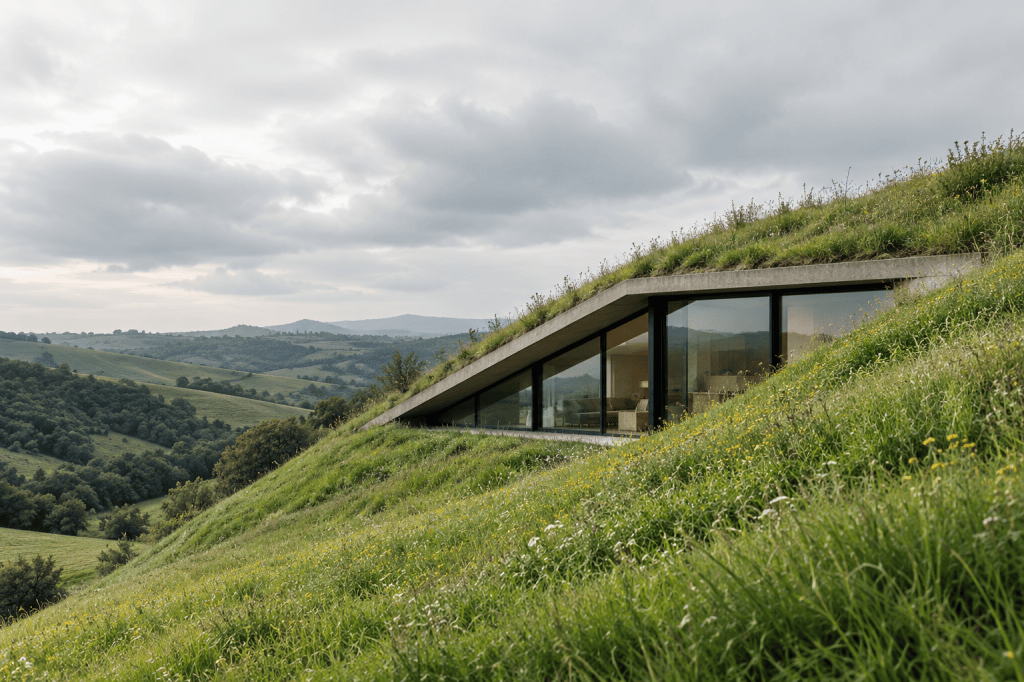
On the quiet relationship between contemporary architecture and the natural world.
Some of the most compelling examples of contemporary architecture are those that make the least effort to be seen.
Rather than imposing themselves upon their surroundings, these buildings respond to the contours of the land, the character of local materials and the changing conditions of the natural environment. Their architectural presence is defined not by monumentality, but by restraint.
Across Europe, a growing number of architects are exploring this quieter relationship between buildings and landscape. Hotels and private retreats have become particularly interesting spaces for such experimentation, offering an opportunity to experience architecture not simply as something to observe, but as something to inhabit.
BUILDING WITHIN THE LANDSCAPE
In the Swiss village of Vals, Villa Vals offers a radical interpretation of architecture’s relationship with nature.
Designed by SeARCH and Christian Müller Architects, the residence is almost entirely concealed within a steep alpine hillside. From a distance, the building is barely visible. Its presence is revealed through a monumental circular opening carved into the mountain.
This circular courtyard introduces daylight into the underground living spaces while framing expansive views of the surrounding valley.
The project challenges the conventional relationship between a building and its site. Instead of placing architecture upon the landscape, the architects have created a space within it.
The result is an unusual sense of intimacy with the mountain, where the surrounding terrain becomes an essential part of the architectural experience.
ARCHITECTURE AS AN EXTENSION OF TOPOGRAPHY
A different approach can be found at Hôtel des Horlogers in Switzerland’s Vallée de Joux.
Designed by BIG — Bjarke Ingels Group in collaboration with CCHE, the hotel follows the natural slope of the site through a striking sequence of stepped volumes.
Its zigzagging form creates a continuous architectural movement across the hillside, while vegetated roofs establish a visual connection with the surrounding meadows.
Rather than concealing the building, the architects have transformed the landscape itself into the organising principle of the design.
The hotel’s geometry remains unmistakably contemporary, yet its relationship with the terrain allows it to feel connected to the wider alpine environment.
Here, architecture does not disappear through invisibility. It becomes part of the landscape through form.
THE QUIET PRESENCE OF WOOD
In the wooded hills of Alsace, France, 48° Nord explores another way of bringing contemporary architecture closer to nature.
Designed by Norwegian architect Reiulf Ramstad, the hotel consists of a collection of distinctive timber cabins inspired by traditional Scandinavian building forms.
Their steeply pitched silhouettes establish a strong architectural identity, while the use of timber creates a material connection with the surrounding landscape.
Positioned across a sloping site, the cabins offer carefully framed views of the Alsatian countryside.
The project demonstrates how a building can remain visually expressive without overwhelming its setting.
Through scale, material and careful placement, the architecture creates a dialogue between contemporary design and the natural environment.
THE VALUE OF RESTRAINT
Although these three projects differ considerably in form and architectural language, they share a common principle.
Each begins with an understanding of its site.
At Villa Vals, the landscape becomes the building’s enclosure. At Hôtel des Horlogers, topography determines its geometry. At 48° Nord, natural materials and carefully positioned volumes establish a relationship with the surrounding terrain.
These approaches suggest that architectural identity does not always depend on visual dominance.
Sometimes, the most meaningful architectural gesture is the decision to build less visibly, to follow the land or to allow natural materials to speak for themselves.
A DIFFERENT WAY TO EXPERIENCE ARCHITECTURE
Architecture designed in close relationship with nature changes the way a place is experienced.
Light becomes more noticeable. Materials reveal their textures. Views are framed with greater intention, and the transition between interior and exterior takes on a particular significance.
For travellers interested in architecture, these spaces offer something beyond conventional hospitality.
They provide an opportunity to understand how a building can shape our perception of the landscape — and how the landscape, in turn, can shape the architecture.
Perhaps the most compelling architecture is not always the architecture that demands our attention, but the architecture that teaches us to look more carefully at the world around it.
